Sunday Letter
Guns, Germs, and Steel

Dear reader, Guns, Germs, and Steel, by Jared Diamond (1997), is a seminal book on historical geography. It races through 13,000 years of human history in just 400 pages, attempting to explain why some societies grew and dominated others. In particular, why agrarian societies dominated hunter-gatherer societies, and why Eurasian civilisation came to later dominate much of the world.
After all, 14,000 years ago the human populations of other continents enjoyed distinct advantages. Africa had the longest history of human occupation. North American had great amounts of fertile land. The Polynesians had incredible sea-faring ability and technology.
Diamond argues that there are three fundamental factors by which this happened: superior weapons leading to military dominance (Guns); Eurasian diseases killing large swaths of local populations, who had no immunity against those diseases (Germs); and durable methods of transportation allowing for the construction and rule over empires (Steel).
Why did these factors arise? Diamond further outlines how geographic, climatic, and environmental forces favoured the development of early, stable agrarian societies.
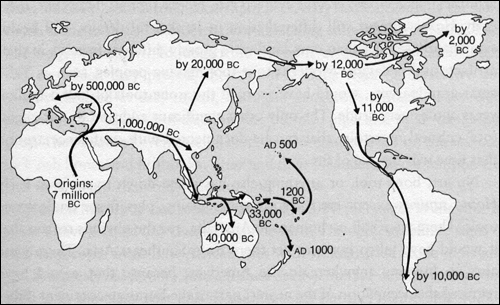
The rise of food production allowed for increased population density, and more importantly, the accumulation and storage of surplus food. This gave rise to the specialisation of labour: supporting armies, bureaucrats, and political elites. Agrarian societies could put down roots, and became sedentary. The gap between birth intervals shrank, leading to increased population density, which further drove the need for food production. Once humanity stopped moving, it could never start again.
The birth of a political class meant empires could be formed and governed. Writing emerged as a way for bureaucrats to keep track of and govern that whole empire. Indeed, most early writing was used to record taxation. Societies’ anointed priests and prophets provided the justification for wars of conquest.
The monopoly over the use of force meant states could maintain public order and curb violence. Societies with effective conflict resolution, sound decision making, and harmonious economic redistribution could develop better technology, concentrate their military power, seize larger and more productive territories, and crush autonomous smaller societies one by one.
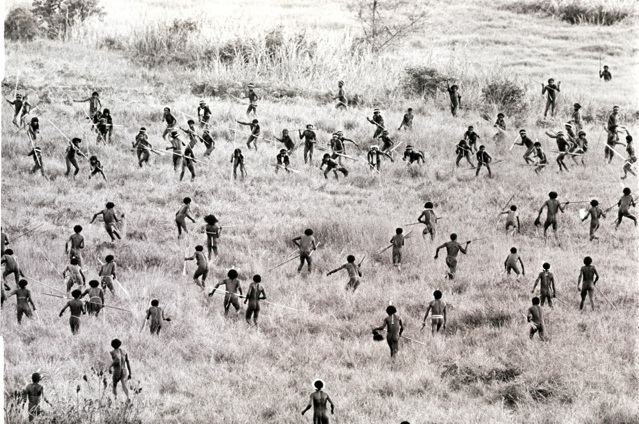
Traditional warfare: Dani tribesmen fighting with spears in the Baliem Valley of the New Guinea Highlands. The highest one-day death toll in those wars occurred on June 4, 1966, when northern Dani killed face-to-face 125 southern Dani, many of whom the attackers would personally have known (or known of). The death toll constituted 5% of the southerners’ population. Photo credit: Karl G. Heider.
Some societies, such as China, had all of those factors. At one point, they were the most technologically advanced society in the world, with the “Four Great Inventions” of paper, printing, gunpowder, and the compass. The treasure fleets of Zheng He in the early 15th century sailed as far away as the Arabian Peninsula and East Africa, consisting of hundreds of ships up to 400 feet long, with total crews of up to 28,000. Why, then, did China not come to dominate the world the way that European civilisation did?
One powerful topic the book discusses is that of how centres of innovation arise, and how innovation spreads. There are many instances throughout history of two competing factions, one pro-innovation and progress, and one-anti. In China, the latter won out, dismantling the fleets and shipyards, and forbidding oceangoing shipping. Japan similarly banned the use of guns, despite its early sophistication in firearms technology.
In both cases, technological isolationism was dramatically ended when foreign invaders sailed upon their shores, forcing both countries to rapidly catch up to the new reality.
Diamond argues that precisely because Europe was fragmented politically for most of its existence, unlike China and Japan, there was no room for similar technological isolationism. Any state that did not adopt guns was rapidly conquered by those who did. China’s initial connectedness gave it an initial advantage, but that same political centralisation ended up giving it a disadvantage. A decision by a single despot could and repeatedly did halt innovation. Europe’s internal geographical and cultural barriers were enough to halt political centralisation, but not enough to halt the spread of technology and ideas.
Technological genies can never be put back in the bottle. As the world today becomes flatter and more interconnected, technological balkanisation cannot last long. There is much ethical debate today about whether or not the world should allow militaries to use weaponised “killer drones”. The problem is that killer drones are inevitable. Once the technology exists, someone somewhere will use it, and others will be forced to likewise adopt the technology, or be surpassed.
The pertinent question is not “if”, but “when”. And more importantly, what to do about such technological change, and how to align ourselves with a rapidly changing world.
Yours Sincerely,
Henry Chong