Sunday Letter
Investment Fallacies: Volatility
Dear reader, A continuation of my series on Investment Fallacies.
I often hear people saying that they are “risk-averse”, or are “conservative investors”. Indeed, standard economic theory would say that all investors are “risk-averse”. But what does that really mean?
Most people, implicitly or otherwise, mean volatility when they talk about risk. Volatility is defined as the degree of variation in price over time, as measured by the standard deviation of logarithmic returns. In other words, how much the price of something moves up or down over a given time period.
It is important to know whether someone is talking about actual volatility, which is based on historical prices until today, or implied volatility, which is based on price movements of a financial derivative (such as a stock option). Financial derivatives can be priced using a wide variety of methods, all of which have pros and cons. For example, the standard Black-Scholes option pricing model has a number of known flaws, and it is unclear how many traders actually use it day-to-day.
Further, it is important to understand the type and shape of distribution that is being assumed. The basic distribution that we all learned about in school is the standard normal distribution. This, however, assumes a state of the world that is almost never (exactly) true. While I won’t go in to all the many and intricate details of different kinds of statistical distributions, it’s worth making sure that you know what distribution is implied.
As Nicholas Nassim Taleb has talked about at length, most real-world distribution have “fat tails”, and are often negatively skewed (bad things may not happen frequently, but when they do, they are often worse in magnitude than when good things happen).

Volatility can also be thought of as the range around an expectation. For example, given a standard normal distribution, if a stock has an expected return of 10%, and has a volatility of 10%, that means that the stock has a 68% chance of returning between 0% and 20%, and a 95% chance of returning between -10% and 30%.
When viewed in this way, volatility can be thought of as the probability of being wrong about a given expectation. It also highlights how widely varying returns can be, if we are not sure about our expectation (which is volatility!)
But does anyone really care about volatility? A stock can be very volatile, but still be going up a lot; conversely, a stock could be very volatile, but have no change in price at the end of a period. For example, in the chart below, both stocks began and ended the period at the same price, although one was a lot more volatile than the other.
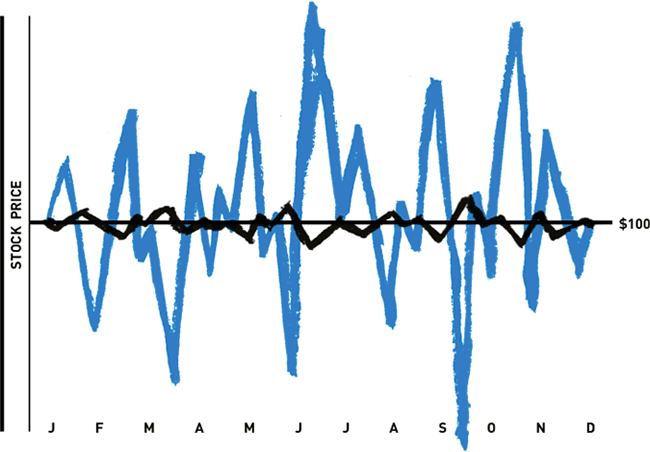
The truth is most people only care about downside volatility: drawdowns. Few care when there is a huge and sudden spike in volatility brought about because something has gone up by a lot.
Truly permanent loss of capital, of course, is another thing to think about. A topic for next week!
Yours Sincerely,
Henry Chong