Sunday Letter
Red Queen Effect
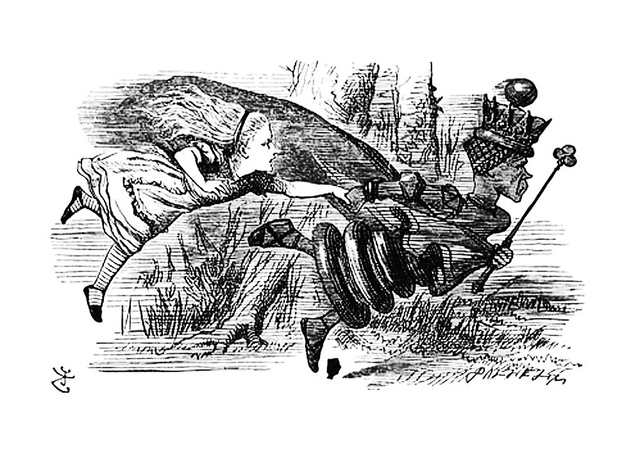
_“Alice never could quite make out, in thinking it over afterwards, how it was that they began: all she remembers is, that they were running hand in hand, and the Queen went so fast that it was all she could do to keep up with her: and still the Queen kept crying ‘Faster! Faster!’ but Alice felt she could not go faster, though she had not breath left to say so.
The most curious part of the thing was, that the trees and the other things round them never changed their places at all: however fast they went, they never seemed to pass anything. ‘I wonder if all the things move along with us?’ thought poor puzzled Alice. And the Queen seemed to guess her thoughts, for she cried, ‘Faster! Don’t try to talk!’
Alice looked round her in great surprise. ‘Why, I do believe we’ve been under this tree the whole time! Everything’s just as it was!’
‘Of course it is,’ said the Queen, ‘what would you have it?’
‘Well, in our country,’ said Alice, still panting a little, ‘you’d generally get to somewhere else — if you ran very fast for a long time, as we’ve been doing.’
‘A slow sort of country!’ said the Queen. ‘Now, here, you see, it takes all the running you can do, to keep in the same place.
If you want to get somewhere else, you must run at least twice as fast as that!’“_
– Lewis Carol, Alice in Wonderland
Dear reader, The passage above from Alice in Wonderland has given rise to what Biologists call the Red Queen Effect: the fact that in evolution, you have to “keep running just to stay still”.
If all animals evolved at the same rate, there would be no change in the relative fitness between species. But, as Darwin famously observed (but as is often misquoted): “It is not the strongest of the species that survives, nor the most intelligent, but the one most responsive to change.”
The species that are better at adapting to their environment and its changes (which biologists call fitness), over time come to dominate.
On the other hand, some species get locked into a never-ending arms race. For example if frogs in a pond evolve longer tongues to better catch flies, but flies correspondingly evolve ever slipperier bodies, then there is no change in the relative fitness between species.
Warren Buffett wrote way back in his 1985 Shareholders’ Letter about how he had decided to shut down Berkshire’s textile business:
_“Over the years, we had the option of making large capital expenditures in the textile operation that would have allowed us to somewhat reduce variable costs. Each proposal to do so looked like an immediate winner. Measured by standard return-on-investment tests, in fact, these proposals usually promised greater economic benefits than would have resulted from comparable expenditures in our highly-profitable candy and newspaper businesses.
But the promised benefits from these textile investments were illusory. Many of our competitors, both domestic and foreign, were stepping up to the same kind of expenditures and, once enough companies did so, their reduced costs became the baseline for reduced prices industrywide. Viewed individually, each company’s capital investment decision appeared cost-effective and rational; viewed collectively, the decisions neutralized each other and were irrational (just as happens when each person watching a parade decides he can see a little better if he stands on tiptoes). After each round of investment, all the players had more money in the game and returns remained anemic.“_
– Warren Buffett, 1985 Shareholders’ Letter
Although the textile business was the origin of Berkshire Hathaway, Buffett was never emotional about it, and approached the decision to divest of the business from a strictly rational capital allocation perspective. He realised that while it seemed like capital investment into the textile business would result in immediate and tangible reduction in production costs and thus profits (an opportunity most CEOs would have seized without a second thought), competitors in what was a commodity industry would quickly step in and compete away any advantage.
His decision to divest and refocus on other industries led to him building Berkshire into the legendary conglomerate it is today.
In life and in business it is important to ensure that you are competing in an arena in which you can outperform not just on an absolute basis, but on a relative basis.
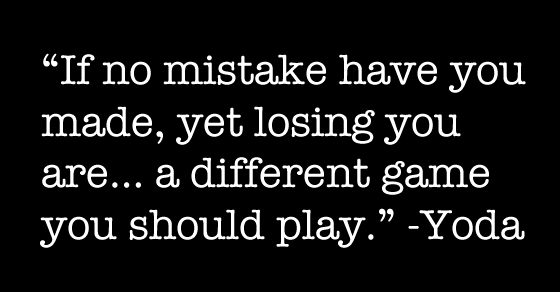
As the wise philosopher once said…
Yours Sincerely,
Henry Chong