Sunday Letter
The best way to get rich during the California Gold Rush
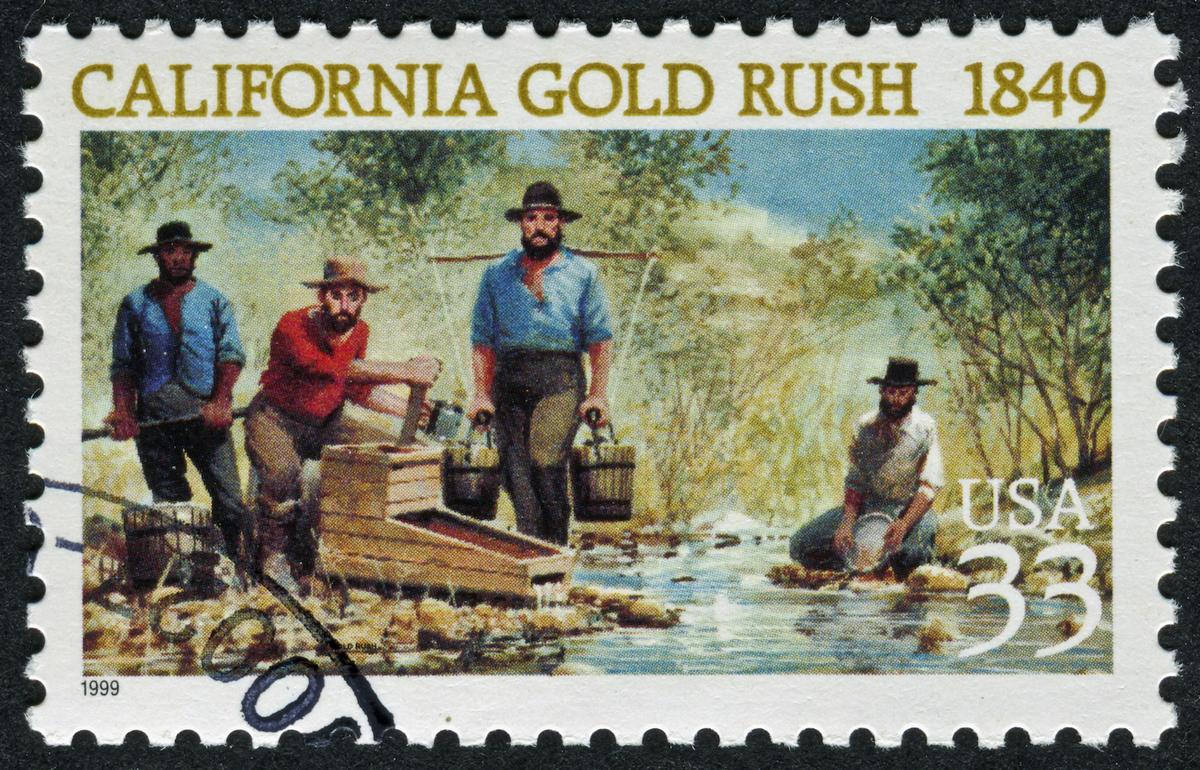
California Gold Rush Commemorative Stamp (issued 1999), US Postal Service
Dear reader, In 1848 James Wilson Marshall discovered gold flakes while panning in a river in Sacramento, California. This sparked a massive gold rush, with the population of the area skyrocketing from less than 1000 people, to more than 300,000 people. This in large part helped California achieve statehood just two short years later, without first becoming a territory. By the time the Gold Rush ended, California had attracted settlers from Latin America, Europe, Australia, and China, and was the home state of the first presidential nominee for the new Republican Party. San Francisco’s population had exploded by 180 times.
In the beginning, gold was easily accessible by simple panning, and there were no clear property rights. Claims were enforced through violence. Native Indians were slaughtered and the environment devastated.
There was no easy way to get to California. Back then there was no East-West railway line. Gold rushers could either sail around the tip of South America, taking 5-8 months; sail to the Isthmus of Panama, and take canoes and mules for a week across the jungle, before boarding another ship for San Francisco; travel over Mexico; or slog through the long California Trail. Many perished along the way.
Upon arriving in San Francisco, gold rushers found a city with scant supplies. Hundreds of supply ships were abandoned after their crews deserted to join the Gold Rush. Many ships were converted into stores and hotels, with some scuttled to turn into landfill.
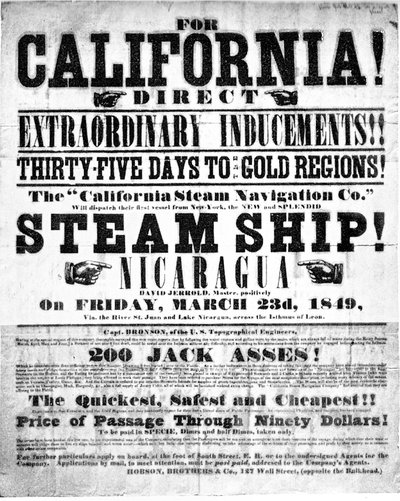
At the beginning of the Gold Rush, California was under military control as it existed in limbo: not being a formal territory, and not becoming a state until 2 years later. There was no government, legislature, or courts. Land was claimed by whoever got there first, with no rights or rules in place, and no practical enforcement mechanisms. It was a free-for-all, with a mad rush to stake claims.
As the Gold Rush progressed, and it became ever more difficult to discover gold, technology was forced to progress and innovate. Miners moved from using pans, to placer mining, to hydraulic mining, to blasting away hard rock with dynamite and extracting gold-bearing quartz.
At the height of the Gold Rush, pans sold for nearly USD 250, and eggs for USD 92, in today’s dollars. Shovels went for over USD 1000. The best way to get rich was not by actually mining gold, but by being a merchant and selling goods to the miners. The richest man in California during the early years of the Gold Rush was Samuel Brannan, who bought all the prospecting supplies in San Francisco, later re-selling them at a substantial profit.
American Express was founded in 1950 by Henry Wells and William G. Fargo, as an express shipping company moving goods and currency. So much money was being made during the California Gold Rush that Wells & Fargo soon started a bank to store it all. At that time, both the express and banking industries were unregulated: anyone with a horse and wagon could start an express company; anyone with a room and a safe could start a bank. Wells Fargo today operates under Charter #1, the first national bank charter issued in the US.
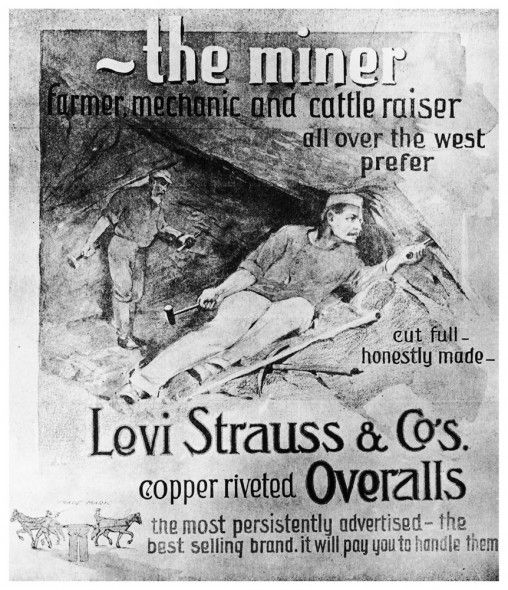
Levi Strauss began selling denim overalls in 1853. Today, 165 years later, they are still worn on the streets of San Francisco by people working in the tech “gold rush”. The products and technologies look vastly different: but it’s still driven by the same basic human emotions.
American Express’s investment banking arm was spun off in 1994 to Lehman Brothers: an institution at the centre of a whole different gold rush.
Yours Sincerely,
Henry Chong