Sunday Letter
WiFi
Dear reader, WiFi is something we all use everyday. Much like the Internet, however, not many people know how it actually works.
WiFi effectively first came about in 1991, when the IEEE 802.11 standard was implemented. Much like other 802 networking protocols, this was a standard for how devices could interoperate and “talk” to each other.
WiFi didn’t hit mainstream adoption until Steve Jobs presented the iBook to the world in 1999 with built-in WiFi. This ushered in a paradigm shift in how we could interact with our computers and devices, and was a precursor to the current mobile revolution, based off of cellular internet technology.
WiFi has come a long way since the original 802.11b standard. The iBook that Steve Jobs demoed had a top WiFi speed on 11 Mbps. Today, WiFi speeds can reach 1Gbps, the same as a wired Ethernet connection.
“Pay attention… How a person handles poor cell service, traffic, and spotty wifi is a good indicator of how they’ll behave during relationship challenges.”
― Steve Maraboli
So what do all the different WiFi standards with all those different letters and buzzwords mean when you’re just trying to buy a router to set up WiFi at home?
802.11b was the original 2.4 GHz standard. The issue with the 2.4 GHz spectrum is that it’s used by many other devices, including for purposes other than communication. For example, microwave ovens transmit their radio waves at that frequency when heating up food, and do so with extremely high power. So yes, it isn’t just you: your WiFi really does get slower when using the microwave.
802.11b, 802.11g, and 802.11n all improved on the original standard, improving on range, bandwidth, and reliability. 802.11n in particular introduced the 5 GHz band, providing much higher throughput in a much “cleaner” channel with less interference, at the expense of shorter range. Most modern routers can switch seamlessly between 2.4 and 5 GHz networks, to select the best one.
802.11n also introduced SU-MIMO: Single-User Multiple-Input, Multiple-Output, meaning that multiple antennas can combine to broadcast to a single device, dramatically improving bandwidth. 802.11ac introduced “beamforming”, where those multiple antennas can be used to triangulate a signal, “locating” where a device is and projecting more power in that direction, allowing signals to travel further with more power.
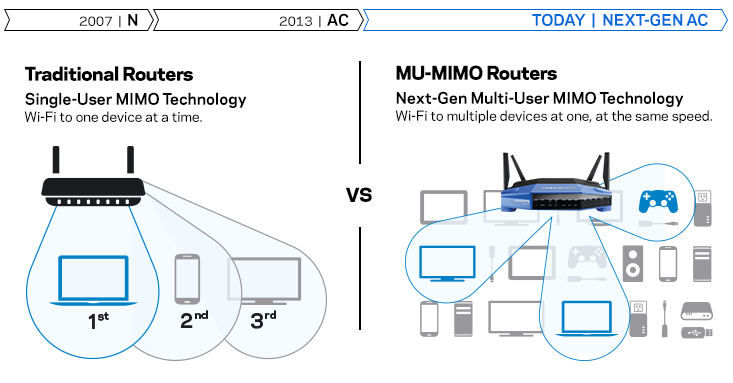
Linksys diagram: SU-MIMO vs MU-MIMO
The latest standard is “802.11ac Wave 2”, which allows for MU-MIMO: Multiple User MIMO. This lets a single router transmit to multiple devices simultaneously, whereas before it could only transmit WiFi to one device at a time, with each device having to wait its turn before connecting.
In 2004, an Economist article forecast the eventual death of WiFi. There have been many premature reports of WiFi’s death since. Despite the rapid and ubiquitous rise of cellular internet, WiFi is more popular and important than ever. Future advances such as 802.11ax, 802.11ah, and 802.11ad will further improve transmission density, range, and bandwidth.
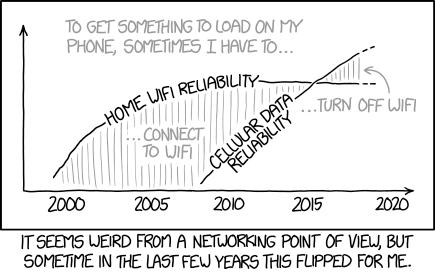
It took roughly 10 years from the public adoption of the Internet, to there being WiFi; 10 years from that to wide-spread adoption of WiFi and the invention of cellular data. Today, 10 years on from the inception of cellular data, mobile internet access is ubiquitous. The entire world is networked, with most people having a smartphone in their pockets that can instantaneously access all the world’s information. Companies such as SpaceX, Facebook and Google are trialling internet projected from satellites, drones, and balloons.
In the next 10 years we will see more and more devices coming “online” through the Internet of Things, and internet access will have virtually global penetration. More Africans today have cellular service (93%) than have access to running water (33%). This explosion in connectivity will radically shift the paradigm for the way that many “essential” services such as banking are delivered to the developing world.
P.S. Yes…using aluminium foil to improve your router strength is a real thing.
Yours Sincerely,
Henry Chong